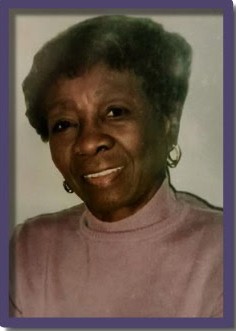
Dr. Rosetta Webster Graham was a pioneering social worker and advocate for children, who delighted in bringing people together at her home and derived a lifetime of fortitude from her faith.
The third of five children born to Richard and Rosetta Graham in the Canton section of what was then Baltimore County, Rosetta grew up there and in Baltimore City. After Rosetta’s mother died when Rosetta was five, the family moved several times before settling on Wolfe Street. Richard Graham set up a shoe-repair and then a grocery business in the front of their rowhouse in part to be available to his young children. Rosetta’s sense of being raised by two parents remained strong, she always said, because her father helped his children feel their mother’s daily presence in their lives.
Rosetta attended public schools. Her family was active at Faith Baptist Church on Bond Street, and as a teenager Rosetta sang in the youth choir and led youth activities. During the summers she organized camping experiences for church and neighborhood children, setting a lifelong pattern of working with youth and encouraging children to have healthy adventures in the outdoors.
While studying sociology at Morgan State University, Rosetta was chosen by the American Friends Service Committee (AFSC) for a summer internship that was part of a project to improve services to mentally ill people and spur the racial integration of mental hospital staffs. The group included Black and white students from around the country. In the two following summers, Rosetta joined similar AFSC teams working in New Jersey and Minnesota.
Taking a leave of absence from Morgan, she led racial integration workshops and then became a staff member at the Trenton (New Jersey) Home for Delinquent Girls, which state law had just integrated. She first regularly attended Quaker meeting in Trenton. At the urging of her father, she returned to Baltimore and Morgan about three years later, completing her undergraduate degree in 1956.
That same year, responding to her experiences with Quakers, Rosetta joined Homewood Friends Meeting in Baltimore. To her recollection, she was the first African American member.
After graduating from Morgan, Rosetta took a job at what became the Training School for Girls in Glen Burnie, Maryland, then a racially segregated school. In 1961 she earned her Master of Social Work degree from Howard University. Rebuffed in her initial attempts to join the social work staff in Johns Hopkins Hospital’s child psychiatry division, she was eventually hired in 1965. That began a distinguished 24-year career as a teacher and therapist at Hopkins. She was the first African American in child psychiatry and the first African American to be appointed to the Hopkins faculty of child psychiatry. In an environment that included individual and institutional racism, she consistently gave respect to and expected it from staff and patients alike.
While at Hopkins, Rosetta became a licensed clinical social worker and earned her doctorate in social work administration and training from the Union Institute in Ohio in a partnership with Morgan State.
About a year after Rosetta’s 1989 retirement from Hopkins , then Baltimore State’s Attorney Stuart Simms asked her to establish a program for those who had lost loved ones to murder in Baltimore City. She designed and became the first coordinator for the Baltimore City Family Bereavement Center, which continues to provide free counseling and support for family members of homicide victims. She encouraged many bereaved people to pursue unrealized goals and especially delighted in the center’s annual camp weekends, where children could just be children. She retired from the center in 2002.
In 2000 the Maryland State Board of Victim Services bestowed their highest award on Rosetta: the Henry Glass Memorial Award. In 2002 the Maryland Chapter of the National Association of Social Workers honored her with a lifetime achievement award.
Beyond her professional work, Rosetta was a central member of her family, nurturing many of the younger generation and taking the role of grandmother to Maka’ya Graham and great-grandmother to Ernest Graham. She sometimes cared for children who temporarily needed love and shelter at her Northwood home. One young person, Sabrina Friday, stayed with Rosetta, and the two forged a lifetime relationship. Rosetta’s household often included a dog: She had three, each named Me-Own. She loved line dancing and, taking up what had been a childhood pursuit, playing the piano.
At Homewood Meeting, she was a valued and plain-spoken counselor, noted for her sharp sense of humor. She performed many roles both at Homewood and in the wider Quaker community: clerk and member of committees, first day school teacher and camp counselor, participant in Friends of African Descent, and later board and committee member for the AFSC Mid-Atlantic Region. In 2007 the AFSC recognized her as one of its “great role models.”
Rosetta opened her home to meeting members and attenders, helping to build the community that she remembered as having warmly welcomed her in her early years as a Quaker. Her concern was often for the young people, many of whom she came to know. She was the sole African American member for many years, and she prompted the Meeting to examine how it was perpetuating racism and how it could play a part in alleviating it.
Rosetta was also welcomed into weekday fellowship at Huber Memorial Church, becoming a member of the Champions of Faith Ministry around 2006. In that group, she gained cherished friends as well as a deeper understanding of the Bible.
Rosetta’s four siblings–Freddie Graham, Richard Graham, Gladys Graham-Tyler, and Gertrude Graham-White–preceded Rosetta in death. Along with her granddaughter and great-grandson, she is survived by a host of nieces, nephews, and friends.
“What I do goes back to growing up in a community where there was so much concern shown for others. It is only by making a contribution, by enriching others’ lives, that life goes on.”
Rosetta Webster Graham
More:
>> Obituary (Baltimore Sun)
 Homewood Friends Meeting
You must be logged in to post a comment.